
This article is one I’ve been meaning to make for a while and with the completely unexpected viewer count my “quitting alcohol” video got, I’ve decided to make this one now and If you’re someone who watched my “quitting alcohol” video and left me a comment, thank you. It means a lot.
This is article about motivation and remaining motivated when attempting to achieve any fitness goal.
As you’ve chosen to read this, having read the title and clicked on it, I’m assuming you have a weight-loss or fitness related goal you’ve been wanting to achieve. As it stands as I write this script, this is part one of a two, maybe three part post (specially about Atomic Habits).
One of the most common questions I get asked, especially on videos relating to the three hardest challenges and/or achievements I’ve ever overcome; giving up alcohol and going completely tee-total, turning Vegan by giving up meat and dairy and then my biggest success; losing over 100kg in body fat – All three I achieved within the past six years (You’ll already know all this if you’ve been a long viewer of my channel), the most common question I get asked is how?
How did I do it? And how did I remain motivated? Because that’s the biggest challenge, remaining motivated! Anyone can quit smoking for a day, go through the process of joining a gym or start a new diet but sticking with it long enough to see tangible results, that’s the key to success. Remaining consistent is the REAL holy grail of weight-loss and fitness success. “if it’s too good to be true, it probably is”
There are a lot of myths, rationalisations and justifications around weight-loss and fitness strategies. There is always someone in the press, on TV or on social media pedalling the next big wonder drug or “get fit quick” scheme. Celebrities have made millions from fitness DVD’s for decades. All you have to do is click on Instagram or turn on any daytime TV show and you’ll be met with yet another face singing the virtues of yet another magic pill or secret hack so the age old saying “if it’s too good to be true, it probably is” has never felt more relevant than it does when applied to the world of fitness influencers however having said all of that I’m also conscious that I’m a bloke on YouTube making videos about fitness challenges and how he’s lost a load of weight so in the same way that I’d advise you to apply the rule “if it’s too good to be true, it probably is” to others online, I’d recommend you do the same with me.
I’m not a doctor, I’m not a nutritionist! Up until the age of 39 (I’m now 45) I wasn’t even very good at making the right decisions for myself, let alone advise anyone else on how best to live their life however I have been through the ring, I have achieved some success and I have picked up a few nuggets along the way.
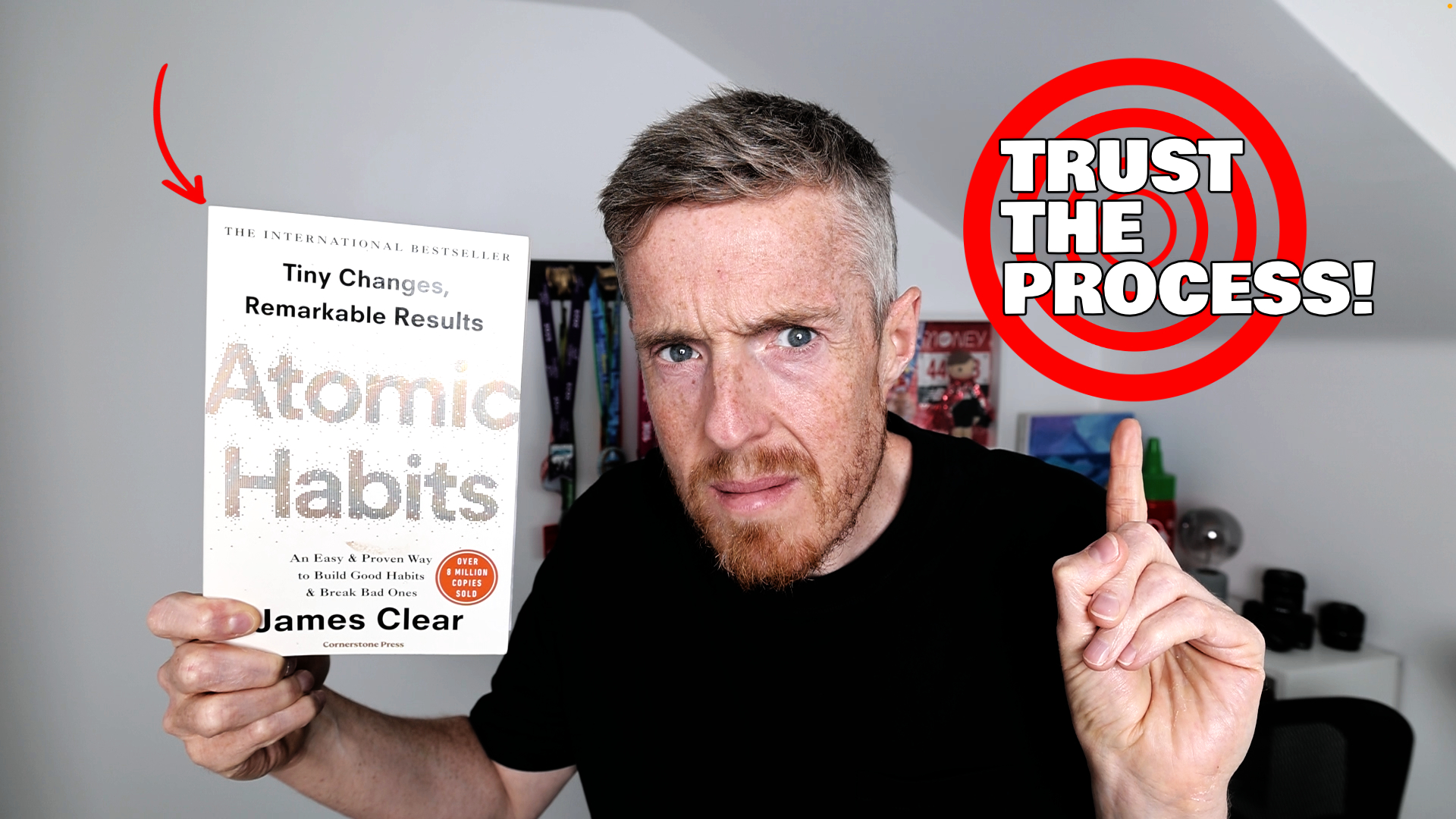
About a year ago I read a book, the book in the thumbnail… Atomic Habits by James Clear. I’ve still got the receipt for it, I don’t know why, I think I used it as a book mark. I bought it in April last year after it was recommended to me by a subscriber and having read it in just three days (devoured it would be a better description), I intended to make a book review video about it however other things took precedence and I never did.
Last week I went on a week long cruise of the Greek Islands with my family, the cruise and my holiday has absolutely no relevance to this post except to say that it afforded me a lot of spare time (something I severely lack in my normal day to day). I’m also right in the middle of making another video titled something like “How I cut my phone screen time”, its about a phone detox challenge that I’m currently still trying to endure. That video will be out soon however the reason I mention this is with no phone to distract me, I decided to completely re-read this book, cover to cover, make extensive notes and write the script for this video. But don’t worry, I still spent time with the fam swimming and eating (I ate a lot) however its amazing how much work I can accomplish, sat in the onboard coffee shop waiting for Tracie and my two daughters to get dressed in the mornings. I know mentioning the length of time my daughters and partner took in the mornings is a cliche and probably not very 21st century of me but this free time allowed me to get my thoughts and views down on paper and for me, that’s a very good use of my spare time. “zero epiphanies or zero moments of realisation”
Getting back to the book, this book really resonated with me as it does a really good job of articulating the steps I took six years ago when I first started on my life changing, slightly unhinged, radical journey and unlike with other self-help books I’ve read (specifically business related ones) that often left me questioning my life choices… when I first read Atomic Habits I had zero epiphanies or moments of realisation. Now, that doesn’t sound great!? “zero epiphanies or zero moments of realisation” are not comments you want to see in a review about your book especially one specially written to give you food for thought however I found myself completely agreeing with everything the writer (James Clear) had written which is a really good thing for the book but also, more importantly, for me. Because he was writing about (and this is going to sound incredibly self-serving which is not my aim here) the literal process I went through at the start of 2019, it was like reading a full breakdown of the steps I took when I decided I needed to lose weight, get fit and remain that way and that’s the key takeaway here… Remaining that way! This book, Atomic Habits, attempts to help you stick with the good habits and break the bad ones. This is exactly what I did and it felt really good to read a book obviously written by someone a lot more intelligent that I am on the subject, validating that what I did… that the steps I took were correct. I mean, it worked regardless. I achieved what I achieved even if the book didn’t validate me but it’s still nice to know that I’m on the side of the angels and I wasn’t wasting my time.
You have to remember that I had absolutely no idea what I was doing six years ago. As I write this, having lived through the process, I know significantly more now than I did back when I woke up one morning (in 2019), morbidly obese weighing in at approximately 190kg, I knew I had to make a change and I really needed that change to stick. I did zero physical activity, obviously because I weighed so much, I had a terrible diet (again, obvious) and I drank for England however even with these very self-destructive bad habits I had one more poor trait that was the most self-destructive; I had every excuse under the sun for why it wasn’t my fault and I rationalised my situation in an attempt to not feel bad about it (and failing miserably)… “My weight problem was genetic”, “I had big bones” and “my metabolism was slower than others”… just a few examples of the nonsense I told myself.
I ate fast food as I had a fast lifestyle and I drank… well, I drank because everyone else did. I’ve already made a video about my history with alcohol and I’ve made several about my weight-loss journey. If you haven’t done so already, please check them out after, I’ll leave a link to them in the description but in a nutshell, it wasn’t until the end of 2018 and the start of 2019 that I eventually acknowledged that my mentality was the cause of my problems and subsequent unhappiness. Being unhappy and wanting to change, that is a big motivator.
Knowing the steps to take to change my life around and fix everything that was wrong with it wasn’t necessarily in my skillset, I should have (could have) given up there but I did have two aces up my sleeve, the first ace was that I wanted to change, I recognised something was very wrong and that’s 50% of the battle! Thankfully I had enough self-awareness to eventually know that all the BS I had believed was wrong and something had to give. The second ace I had tucked up my other sleeve was that I was (at the time) a corporate manager within a very big corporate business, which ironically was a big part of my problems (again please go and watch my “quitting alcohol” video for more context) but it was also part of the solution. You see, I knew how to effectively manage large teams of people… I was very good at motivating others to perform well. So, I decided to take the one thing I was good at (motivating others) and turn that torch light back on myself. I was going to motivate the shit out of my problem until the solution suddenly manifested itself.
The writer starts this book, like any good story book describing a life altering event he experienced, resulting in a serious injury that ultimately led him through a series of unfortunate events culminating in a happy ending where he eventually discovered how to change his life, I’m summarising obviously.
It’s actually quite a good story and one I won’t spoil for you here but the first really important point he makes in the book is about the huge value of “the aggregation of marginal gains”. He talks about the “mediocre” performance of the British Cycling team at The Tour De France, something I’m really interested in. I watch The Tour every year now since I fell in love with cycling a few years ago and he goes into detail about British Cycling’s (then) newly appointed performance director, Dave Brailsford’s revolutionary new approach that completely turned around the fortunes of the British team which up until 2003 had been disappointing at best. Now interestingly and as a quick side-note, as part of the research I did for this video when writing the script and James Clear does add in a footnote to accompany his British cycling team example but there have been some controversies to the tactics that the team actually employed but as he goes on to clarify on his website (and I’ll leave a link to that in the description), this first chapter isn’t about cycling and the point he makes about small, consistent incremental gains is still a valid one and I agree with him here. Controversial cycling tactics aside, the power of tiny 1% daily gains when trying something new is huge.
Initially I made two obvious huge changes to my lifestyle, I gave up booze (went teetotal) and gave up meat and dairy (turned Vegan). Not on the same day, I took these steps some time apart but they felt necessary for my overall wellbeing and continued success. Giving up booze was an obvious advantage for my weight-loss and fitness ambitions, I thought of it like trying to fly a jumbo jet whilst simultaneously setting fire to the engines. Trying to achieve anything positive whilst still drinking would just be self-sabotage. However, giving up meat and dairy had another less obvious benefit, aside from the other health advantages of less (or no) dairy or red meat in my diet was that was that I had to read all of the ingredients in everything I ate, this made me an overnight amateur nutritionist. I suddenly knew what was going into my body and I was able to efficiently and effectively manage my calorie intake and remove food products that were either detrimental or excessive. There’s a lot more to this and of course you could achieve the same lower calorie intake without giving up meat and dairy but the fact that I was now forced slowly re-learn my daily eating habits meant, by association that I also started to understand what I was actually eating, what I needed to remain active and healthy and probably the biggest learning curve of all, what I didn’t need as it was bad for me, except vegan ice-cream… ice-cream is not bad for me.
I also started walking, I walked as far as I could pretty much everyday, initially this wasn’t very far, to the end of my road, then to the end of the next road, then to the park, then around the park… I tried to go slightly further everyday and I did this for roughly two years until I lost enough weight that I could attempt to run (or shuffle), I then kept trying to run short distances intermixed with long walks until I could run further for longer and longer eventually ending in running my first parkrun, 10k, marathon and then 100k ultra-marathon.
The concept of small, tiny 1% incremental gains is probably the best piece of advice this book offers anyone starting out for the first time and it comes within the first chapter. It doesn’t lead you in slowly, it hits you hard from the off with its biggest win.
When starting a new diet or joining a gym for example, the biggest reason people quit is the amount of effort and willpower required to see results. We think about the task as a whole and we need to see results to balance out the sacrifices were trying to make. The book talks about “The Plateau of Latent Potential”, when a switch is suddenly flicked and you eventually see the progress either on a Strava graph, in a mirror, or on the scales. To everyone else, it looks like an overnight success but to you, it’s the culmination of all the hard-work and sacrifices made. This is the point you need to reach that helps you break your bad habits and stick to these newer, harder ones. Prior to this tipping point, everything potentially feels pointless. He uses an ice cube as an example, I’ll use boiling water. We all know the boiling point of water is one hundred degrees, as the pot of water on the gas moves through the temperature range from zero to one hundred, we don’t see a lot of action, especially for 99% of this process. It’s only when it hits boiling point that it starts bubbling away. Think of the first 99% of this process as your diet or training plan, it would be easy to think its not working and you’d have justification to just give up but if you trust the process then you’ll reach boiling point where you’re significantly less likely to quit on your goals.
If I eventually do write a book on this subject then I’ll have a whole chapter titled “TRUST THE PROCESS” as its the best piece of advice I can give anyone, just start, don’t over think it, keep it simple and trust the process.
The book also talks about goals vs systems and that we need to focus more on the processes and systems than on our goals. “Goals are about the results you want to achieve. The systems are about the processes that lead you there”.
I’ve mentioned this before in previous videos, I’ve talked about changing the reason you’re making the change in the first place… If you start a diet because you want to fit into your summer beach bikini or you join the gym because you want to look like that guy off Gladiators then you’re doomed to failure from the start for many different reasons but the main one, your motivation to do it just isn’t strong enough. When it gets hard, looking like “Legend” suddenly doesn’t become that important and the reward vs effort required simply do not balance out and you inevitably return to your old habits. You need a good reason to do it and only you can decide what that is.
“The systems are about the processes that lead you there”. In the example of starting a new diet for weight-loss, part of the process might involve you removing all snacks, sweets and chocolates from the house (leave the ice-cream, that’s good for your mental health). This allows you to focus on other parts of the process or plan such as having three sensible and portioned controlled meals a day with zero snacking in-between. If you stick to this very simplistic plan with zero temptations (except the ice-cream) then you’re far more likely to have achieve your end-goal and subsequent happy place (eating ice-cream).
It’s also never a good long-term motivator to try to copy or emulate anyone you see online. It’s good to take inspiration from those you see doing good things, making change stick and who look like they’ve got all the answers. Inspiration is good… emulation is bad. Instead, try and focus on the things you know will work for you. I’ve mentioned it before about finding your “happy place”, I used the movie hook as an example in older videos where the lost boys teach robin Williams’ Peter Pan to fly by helping him find his happy place aka his motivation.
If you can find a slightly more powerful motivator than squeezing into your budgie smugglers for that trip to Benidorm in a few months then you’ll have a slightly higher chance of success when things start to get hard.
For me my motivation is and always has been my family. Losing weight, getting fit and remaining that way has afforded me so much more than before. I’m able to do things I could only dream of six years ago, I’m now the fastest and fittest person I know, having the ability to climb mountains, run really long distances and cycle upright (sometimes) has given me a new lease of life. Because I’ve broken through the “plateau of latent potential” many times now, to return to my old bad habits and risk losing what I’ve achieved is just not worth it, the sacrifices don’t feel as bad and my new habits seem automatic mainly because they’re habits and not tasks. I also think a lot about the future. If I’ve achieved all this within the past six years when most of that was spent working through the 1% incremental growth stage, imagine what I can accomplish in the next six, twelve, twenty-four years? I might even finish a long bike ride without falling off.
Thanks for watching, I hope this has helped inspire you.
In the next parts of this video I’m going to talk about using your strengths to help maintain good habits, having and maintaining a positive mindset, calling out the BS and other things full of buzz-words. I’ll context it all with what I’ve done to hopefully give you some inspiration.
Please don’t forget to let me know what you thought of this video in the comments below.
See you in next weeks video.
Leave a Reply